
Fighter jets. Submarines. Precision-guided weapons. Radar systems. Advanced communications.
The minerals behind these technologies are essential to military readiness. Yet many pass through supply chains dominated by China, creating vulnerabilities that extend well beyond the commercial marketplace.
A disruption in access to even a small quantity of a specialized mineral can affect the production, maintenance, or modernization of complex defense equipment. That makes reliable mineral supply an important consideration for military planning and long-term industrial readiness.
Ocean minerals offer another potential source of strategic materials that can help the United States strengthen its defense industrial base, diversify supply chains, and reduce dependence on foreign competitors.
The Minerals Behind Military Readiness
Modern defense systems rely on a wide range of critical minerals.
Rare earth elements are used in powerful permanent magnets found in motors, sensors, actuators, and guidance systems. Nickel, cobalt, copper, and manganese support batteries, electronics, specialized alloys, and other technologies essential to defense manufacturing.
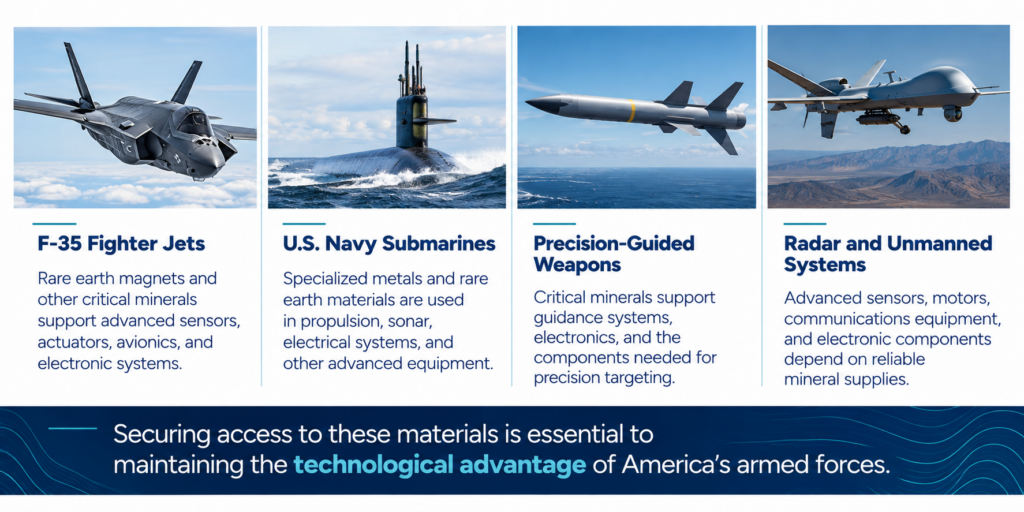
For example, the F-35 fighter jet incorporates critical minerals in advanced electronic systems and components. U.S. Navy submarines depend on specialized metals and materials for propulsion, sonar, and electrical systems. Precision-guided weapons and unmanned systems similarly rely on high-performance sensors, electronics, and motors.
These materials help power and support some of America’s most important military capabilities.
China’s Control Creates Strategic Vulnerabilities
China has spent decades building a commanding position in the global critical minerals supply chain, particularly in processing and refining.
Today, China accounts for roughly 90% of global rare earth processing. That concentration gives Beijing considerable influence over materials used in American defense systems and advanced manufacturing.
China has already demonstrated its willingness to use that position. Export restrictions on gallium, germanium, antimony, and rare earth-related products have exposed the risks of depending on a limited number of foreign suppliers for strategically important materials.
For American defense manufacturers, disruptions can mean higher costs, longer lead times, and uncertainty over access to essential components.
These risks extend through multiple stages of the supply chain. Even when minerals are extracted outside China, they may still depend on Chinese processing facilities before becoming usable metals, alloys, magnets, or other components.
A strong defense industrial base requires reliable access to raw materials and the industrial capacity to turn them into usable products.
The Strategic Seafloor
The competition for critical minerals is extending into the deep ocean.
China has secured exploration contracts through the International Seabed Authority, covering polymetallic nodules, cobalt-rich crusts, and seafloor massive sulfides in international waters. It has also invested heavily in oceanographic research, advanced vessels, seabed mapping, and deepwater technology.
Chinese entities hold five exploration contracts through the International Seabed Authority, providing opportunities to study different mineral deposits while advancing the technologies and operational experience needed to work in deep ocean environments.
These activities have implications beyond mineral development. Detailed knowledge of underwater terrain and ocean conditions can also support naval operations, submarine navigation, and other maritime capabilities.
The vessels, sensors, autonomous systems, and mapping technologies used in mineral exploration have applications across ocean science, commercial maritime operations, and national security. Developing these capabilities also helps build the specialized workforce and industrial infrastructure needed to operate in challenging offshore environments.
As China expands its presence in the deep ocean, American leadership in ocean science, exploration, and technology becomes increasingly important.
A New Source of Strategic Minerals
Ocean mineral resources could help diversify the materials available to American industry and national defense.
Polymetallic nodules contain nickel, cobalt, copper, and manganese. Other seabed deposits contain additional strategically important materials, including certain rare earth elements.
These resources could support a range of defense-related supply chains, from specialized alloys and electrical systems to advanced electronics and components. Different deposit types offer different combinations of minerals, creating opportunities to diversify the materials available to U.S. manufacturers.
Developing these resources could provide the United States and its allies with additional mineral supply options, complementing domestic mining, recycling, and partnerships with trusted nations.
But recovering minerals is only the beginning. The United States also needs processing, refining, and manufacturing capacity to turn raw resources into the materials used by defense contractors and American manufacturers.
Recent processing demonstrations have shown that polymetallic nodules can be treated using existing industrial equipment, including a pilot campaign conducted through a commercial ferronickel production line in Japan. While further investment and testing are needed to establish commercial-scale operations, these efforts illustrate how established industrial technologies could support new mineral supply chains.
Strengthening America’s Strategic Position
The United States already possesses much of the offshore expertise needed to participate in this emerging industry.
American companies have decades of experience with advanced vessels, subsea robotics, geophysical mapping, deepwater engineering, and complex offshore operations. These capabilities have been developed and refined through decades of offshore energy activity, particularly in the Gulf of America. Dynamic positioning systems, remotely operated vehicles, subsea equipment, and advanced sensors provide a technological foundation that can be adapted to ocean mineral exploration and potential development.
Applying those capabilities to ocean mineral development, alongside rigorous environmental research and oversight, offers an opportunity to strengthen America’s industrial and technological leadership.
Cooperation with allied nations can further expand access to mineral resources, strengthen scientific partnerships, and support the development of supply chains less vulnerable to disruptions or foreign government restrictions.
Greater access to mineral resources, expanded domestic processing, and continued investment in American offshore capabilities can help build a more resilient defense industrial base.
America’s national security depends in part on securing the materials behind its military strength. Ocean minerals can be part of that effort.
Explore More
Read Below the Surface: Securing America’s Industrial Future from the Seafloor Up for a deeper look at critical minerals, national security, and the strategic importance of the ocean.