

We don’t have to build this capability from scratch.
The companies, vessels, workers, ports, engineering firms, technology providers, and supply chains that support America’s offshore industries today can play many of the same roles in ocean mineral development.
From dynamically positioned vessels to underwater robotics and advanced mapping systems, technologies developed for offshore energy are already being adapted for mineral exploration, environmental research, and potential resource recovery.

Marine Engineers

ROV Pilots
Vessel Crews

Geophysical Surveyors

Subsea Specialists

Fabricators
Port Workers

Processors
An Industrial Base Already in Place
For decades, America’s offshore industries have built complex supply chains capable of supporting operations far from shore and thousands of meters below the surface.
Many of the capabilities ocean mineral development will require are already commercial businesses today. U.S. companies provide geophysical surveys, subsea engineering, robotics, vessel operations, fabrication, logistics, environmental services, data analysis, and offshore project management around the world.
In the Gulf of America, these capabilities support offshore operations involving sophisticated vessels, subsea production systems, remote monitoring, and equipment operating thousands of meters below the surface. That experience provides a foundation for addressing many of the engineering challenges associated with ocean mineral development.
The people behind those industries also bring something that cannot be created overnight: experience. Marine engineers, ROV pilots, subsea systems operators, geophysical surveyors, and vessel crews already perform jobs that translate directly to ocean mineral development.
Their expertise in vessel positioning, subsea equipment deployment, remote operations, and offshore safety can help reduce the need to develop entirely new operational capabilities. However, different mineral deposits and collection methods will still require specialized equipment, testing, and training.
Building the Future
A new ocean minerals industry would not exist in isolation. It would connect to an established network of American industries and capabilities.
A commercial operation needs vessels and crews offshore. It needs shipyards and fabrication facilities to build and maintain equipment. It needs ports to support operations and move material. It needs engineers, environmental scientists, geoscientists, and technology companies. And it needs processing and refining capacity to transform raw resources into useful materials.

For example, potential nodule collection systems can combine remotely operated or autonomous underwater vehicles, subsea pumps, lifting equipment, and surface vessels. Many of these individual technologies have established offshore applications, even as their integration for commercial mineral recovery continues to advance.
That creates opportunities throughout the supply chain — offshore and onshore.
Ports, Processing, and American Jobs
The economic opportunity does not stop at the water’s edge.
Commercial ocean mineral development would connect offshore operations with ports, shipyards, logistics providers, processing facilities, manufacturers, and communities across the country.
Ports can serve as operating bases for vessels, crews, equipment, maintenance, logistics, and material handling. Shipyards and fabricators can build and service specialized vessels and subsea systems. Processing and refining facilities can turn recovered resources into the metals American manufacturers need.
Existing offshore industry hubs offer access to experienced maritime workers, industrial facilities, transportation networks, and specialized service companies. These established capabilities could help support ocean mineral projects while creating opportunities for businesses already serving the offshore energy industry.
Beyond vessel crews and offshore engineers, the industry could support jobs in equipment manufacturing, port operations, environmental science, metallurgy, logistics, and advanced manufacturing. Many of these occupations already exist within America’s maritime and industrial workforce.
The Opportunity Continues Onshore
Recovering minerals is only the beginning. Their economic and strategic value grows as more of the supply chain takes place in the United States.
Processing is particularly important. Domestic facilities could potentially handle material from U.S. offshore resources alongside terrestrial and allied sources, meaning investment in processing capacity can serve a broader mineral supply base rather than a single project or feedstock. The report specifically identifies North American engineering expertise and existing nickel, copper, and zinc refining capabilities as part of that foundation.
Recent pilot-scale work has demonstrated that polymetallic nodules can be processed using an existing commercial ferronickel production line. The demonstration in Japan produced a nickel-copper-cobalt product and manganese-rich material, illustrating how established metallurgical technologies could be adapted for ocean minerals.
Commercial-scale processing will still require further investment, engineering, and testing. But building on existing industrial knowledge offers a potential pathway to develop new processing capacity in the United States.
Co-locating processing and refining can also create operational efficiencies while supporting additional investment, construction, technical employment, and manufacturing activity onshore.
Deepwater ports, access to energy, transportation infrastructure, and an experienced industrial workforce will all be important considerations as companies evaluate potential processing locations.
The Industrial and Economic Potential of Seabed Minerals
Critical minerals sit near the beginning of enormous economic value chains.
They become the materials used in advanced manufacturing, defense systems, transportation, electronics, energy infrastructure, and emerging technologies. Building more of the mineral supply chain in the United States therefore creates an opportunity that extends well beyond the value of the resource itself.
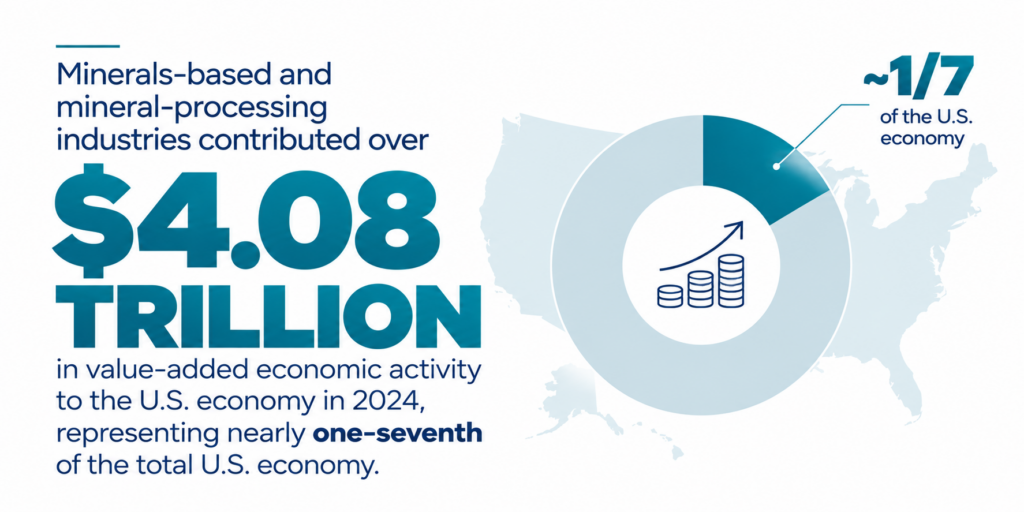
The broader U.S. minerals industry already demonstrates that multiplier effect: mineral commodities feed industries responsible for trillions of dollars in economic activity. According to the U.S. Geological Survey, minerals-based and mineral-processing industries contributed more than $4.08 trillion in value-added economic activity to the United States in 2024, representing nearly one-seventh of the nation’s economy.
Ocean minerals can expand the resource base supporting that activity while generating new investment across vessels, ports, processing, manufacturing, technology, and the offshore supply chain.
While the economic contribution of a future ocean minerals industry will depend on commercial development and domestic investment, the scale of America’s existing mineral-dependent industries illustrates the importance of securing reliable supplies of raw materials.
More Than a New Source of Minerals
An American ocean minerals industry can do more than diversify mineral supply.
It can create new demand for American vessels and shipyards. New opportunities for offshore workers and engineers. New activity at American ports. New investment in processing and refining. And new inputs for manufacturers competing in industries that will define the decades ahead.
The benefits could extend beyond mineral development itself. Investment in ocean exploration, robotics, environmental monitoring, and subsea engineering can strengthen capabilities used throughout America’s offshore economy.
The opportunity is to put that experience to work in a new industry, connecting American offshore innovation with the mineral supply chains that will support the nation’s economic and industrial future.