
One of the world’s greatest untapped mineral resources lies beneath the ocean.
Across the seafloor are enormous deposits containing nickel, copper, cobalt, manganese, rare earth elements, and other critical minerals. These resources occur in different forms and environments, but together they represent an opportunity to expand America’s mineral resource base at a scale that could matter for generations.
Advances in offshore mapping, remotely operated vehicles, autonomous systems, and deepwater engineering are making it possible to better understand resources that were once largely beyond reach.
One Resource, Multiple Metals
Unlike many conventional mineral deposits developed primarily for a single commodity, some ocean mineral resources contain several strategically important metals together.
Polymetallic nodules, for example, can contain manganese, nickel, copper, cobalt, and rare earth elements. Other offshore resources contain different combinations of copper, zinc, titanium, zirconium, rare earth elements, and other valuable materials.
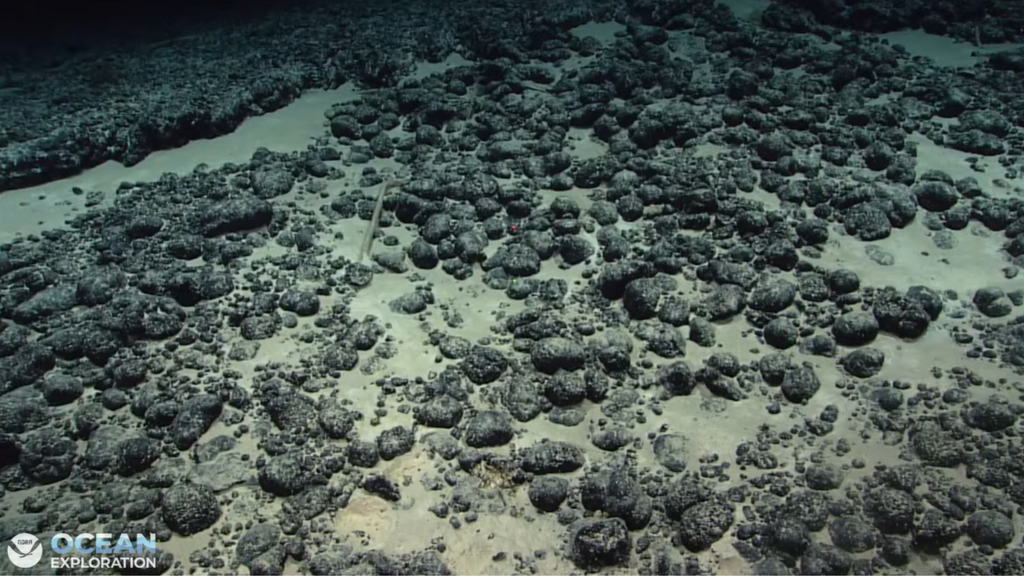
These resources take several forms. Polymetallic nodules rest on the seafloor, cobalt-rich ferromanganese crusts form on hard surfaces such as seamounts, and polymetallic sulfide deposits develop around hydrothermal systems. Other offshore deposits include heavy mineral sands and phosphorites, each with distinct mineral characteristics and development considerations.
That diversity makes the ocean more than a source of any one mineral. It represents a potentially significant new resource base for multiple American supply chains. Recovering and processing several valuable metals from a single deposit could create opportunities to support multiple industries, although the economics and technical requirements will vary by resource type.
The Scale of the Seabed Resource Base
The significance of ocean minerals becomes clearer when you look at the scale.
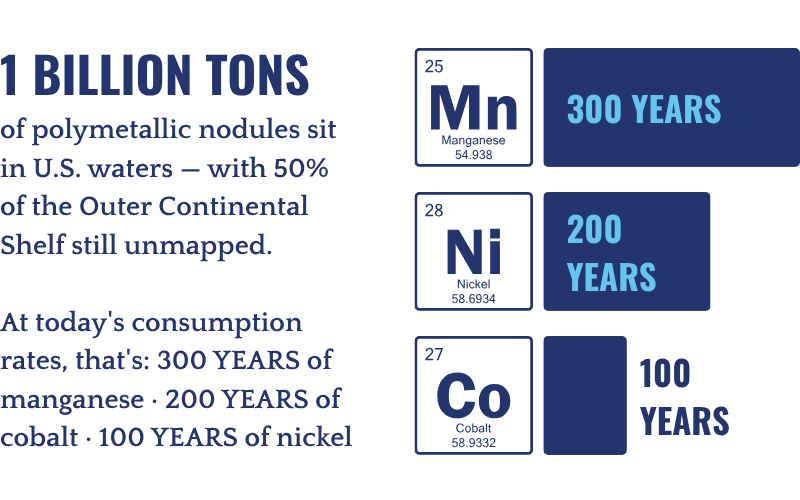
Polymetallic nodules alone occur across vast areas of the deep ocean. In U.S. waters, the estimated resource could total approximately 1 billion tons — and much of America’s offshore territory has yet to be fully mapped and characterized.
These estimates point to substantial mineral potential, but the presence of a resource does not automatically mean it can be commercially recovered. Further exploration, environmental research, engineering, and economic evaluation will help determine which deposits may be suitable for future development.
A Vast and Diverse Resource Base
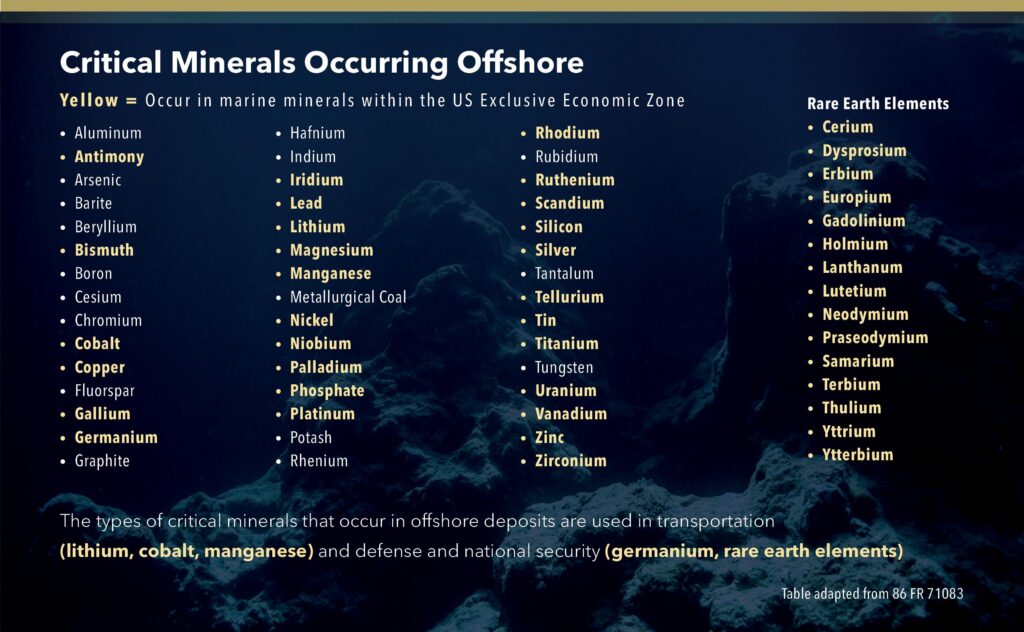
Across the U.S. Outer Continental Shelf, different geological environments can host different combinations of critical minerals. According to the U.S. Geological Survey’s 2025 critical minerals list, 43 of the 60 listed minerals occur on the Outer Continental Shelf. This illustrates the diversity of offshore mineral resources, from shallow-water deposits to minerals found thousands of meters below the ocean surface.
And the opportunity extends beyond U.S. waters. The Clarion-Clipperton Zone in the Pacific contains one of the world’s largest known concentrations of polymetallic nodules. Estimates place the region’s nodule resources at approximately 20 billion tons, containing minerals important to manufacturing, energy technologies, and defense applications.
The scale is large enough to potentially reshape the global mineral supply picture as exploration, environmental science, and processing technologies advance.

A New Source for America’s Industrial Future
The United States will need minerals from many sources. Terrestrial mining, recycling, allied supply, and new resources will all have roles to play.
Ocean minerals add something potentially transformative to that mix: large, multi-metal resources that can expand and diversify the mineral base available to American industry.
Realizing that potential will require more than access to the seafloor. It will also depend on mineral processing capacity, transportation infrastructure, investment, environmental research, and a predictable regulatory framework. America’s established offshore industry offers capabilities and experience that can help support this emerging sector.
America has an opportunity to better understand and develop these resources as part of a broader strategy to strengthen mineral supply chains. And with global demand rising, the importance of expanding those options is becoming increasingly clear.