
AI and data centers. Defense systems. Advanced manufacturing. Energy infrastructure. Transportation. They require enormous quantities of copper, nickel, cobalt, manganese, rare earth elements, and other critical minerals — often the same minerals, at the same time.
Demand is accelerating and the more advanced our economy becomes, the more important mineral supply becomes.
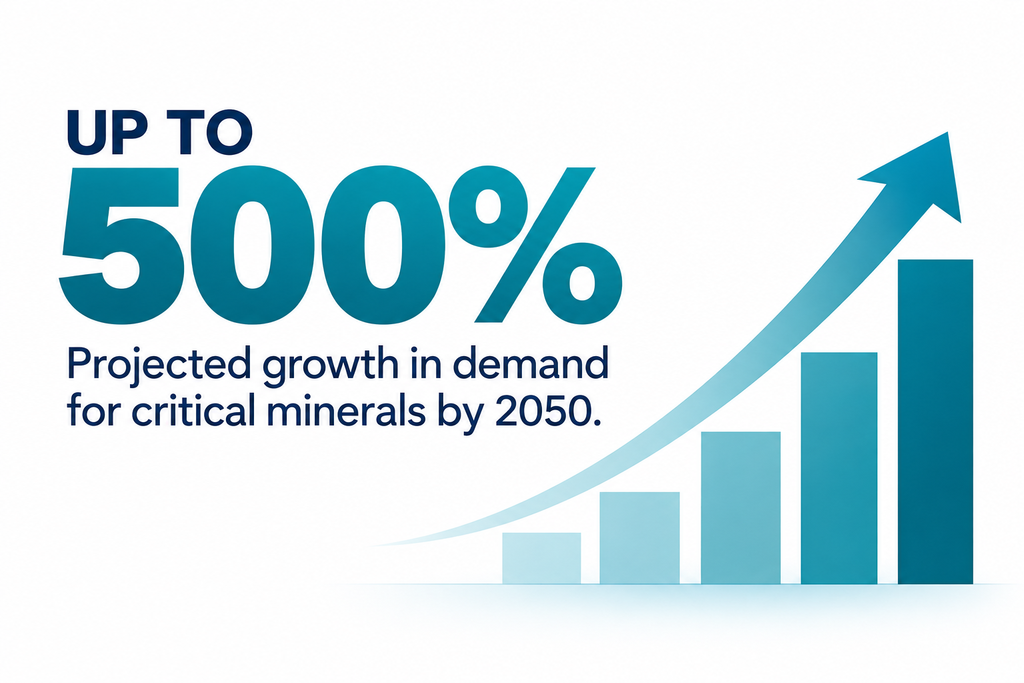
The World Bank has projected that demand for certain minerals used in energy technologies could increase by nearly 500% by 2050. Meeting growing demand across the broader economy will require substantial investment in new mineral resources, processing capacity, and supply chains.
The Digital Economy is Built on Physical Infrastructure
Artificial intelligence may operate in the digital world, but the infrastructure behind it is intensely physical.
Data centers require enormous quantities of copper and other minerals. So do the power plants, transmission lines, substations, transformers, and grid infrastructure needed to supply them with electricity.
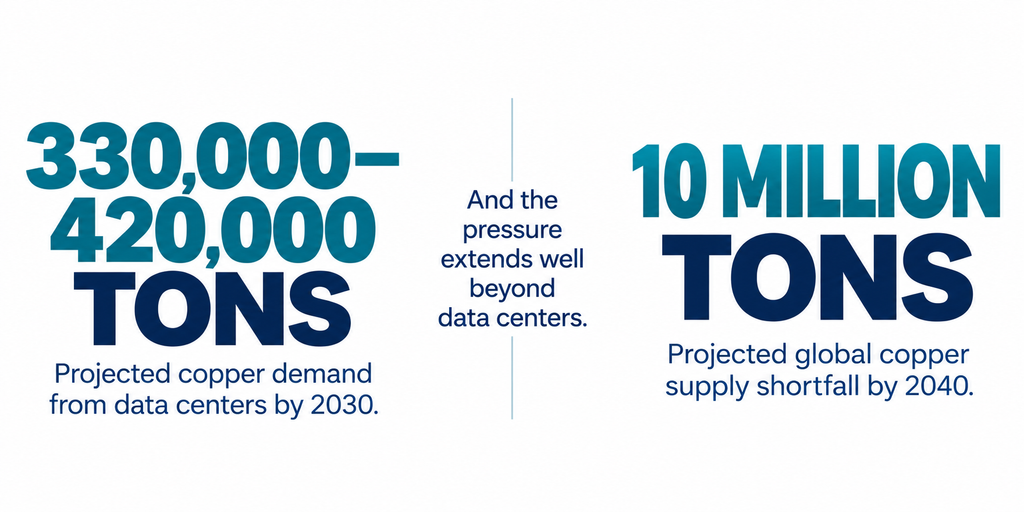
Data centers alone could require an estimated 330,000 to 420,000 tons of copper by 2030. Meanwhile, projections of a potential global copper supply shortfall approaching 10 million tons by 2040 illustrate the broader challenge of expanding production quickly enough to meet demand.
AI runs on data, but the infrastructure behind AI runs on minerals.
The Same Minerals. More Competing Demand.
The challenge is not simply that the world needs more minerals. More industries are competing for many of the same materials.
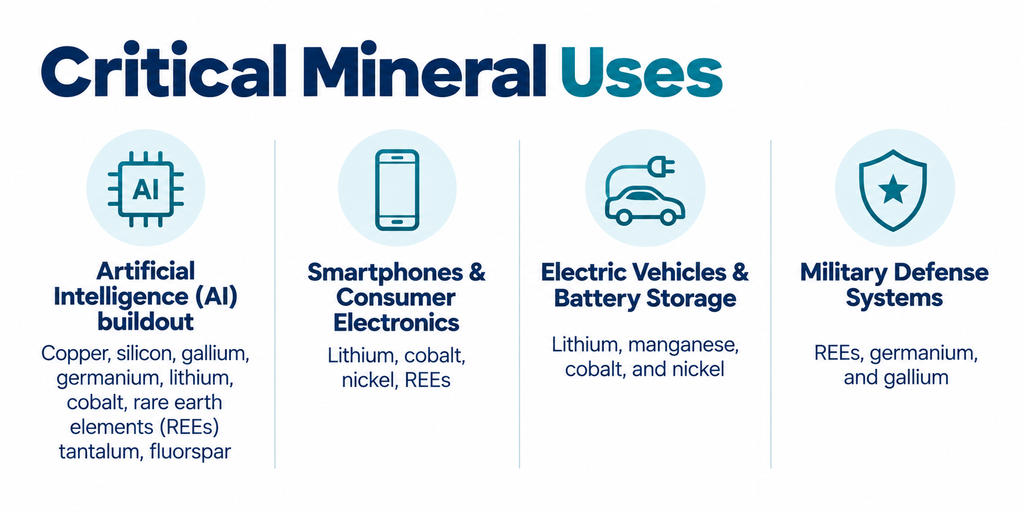
Copper is needed for electrical infrastructure, electronics, and industrial equipment. Nickel, cobalt, and manganese are important for batteries and specialized alloys. Rare earth elements, gallium, and germanium support technologies ranging from advanced electronics and communications systems to defense applications.
A disruption involving even a relatively small-volume critical mineral can ripple through sophisticated manufacturing and technology supply chains.
For manufacturers, reliable access to these materials is essential to planning investments, maintaining production, and bringing new technologies to market.
New Supply Takes Time

Demand can grow quickly. Mineral supply development generally will not be as fast.
Finding a resource is only the beginning. New terrestrial mines must move through exploration, engineering, financing, permitting, construction, and ultimately production — a process that can take decades.
According to S&P Global, developing a new greenfield mine in the United States takes an average of approximately 29 years. That timeline makes it difficult for new production to respond quickly to changing industrial needs.
That mismatch matters. Industries are making investments today based on mineral needs that will extend decades into the future, while many potential new sources of supply will take years to reach the market.
Expanding America’s mineral supply therefore requires planning well ahead of demand, including investment in exploration, new technologies, and the infrastructure needed to bring additional resources into production.
Different Resources, Different Roles
There is no single answer to America’s mineral challenge.
Terrestrial mining will remain essential. Recycling can return valuable materials to the supply chain. Allied production can diversify sourcing. Ocean minerals can provide another potentially significant source of raw materials.
And different ocean mineral resources can contribute different combinations of metals.
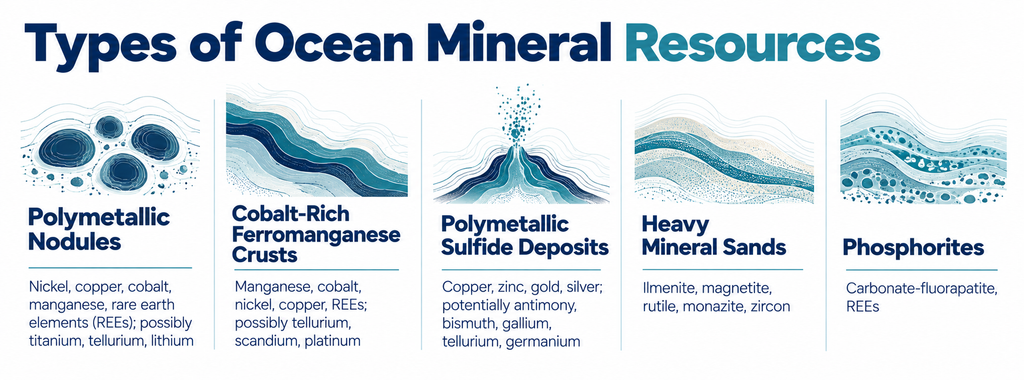
Polymetallic nodules offer nickel, copper, cobalt, and manganese. Cobalt-rich crusts contain metals used in specialized alloys and advanced technologies, while seafloor sulfide deposits can contain copper, zinc, and other valuable materials. Heavy mineral sands provide another offshore source of minerals used in manufacturing and industrial applications.
Each resource presents different opportunities, technical requirements, and environmental considerations. Together, they could broaden the range of mineral supply options available to American industry.
In the Driver’s Seat
How China Came to Dominate Critical Mineral Supply Chains
The strategic challenge extends beyond how much mineral supply exists. It also matters where that supply comes from and who controls the steps required to turn a resource into a usable material.
Over decades, China built dominant positions across significant portions of global critical mineral mining, processing, and refining. That concentration gives Beijing influence over materials essential to advanced manufacturing, technology, energy, and defense.
China accounts for approximately 70% of global rare earth extraction and roughly 90% of rare earth processing. Its influence extends across other mineral supply chains through investments in mining operations, refining facilities, and manufacturing capacity around the world.
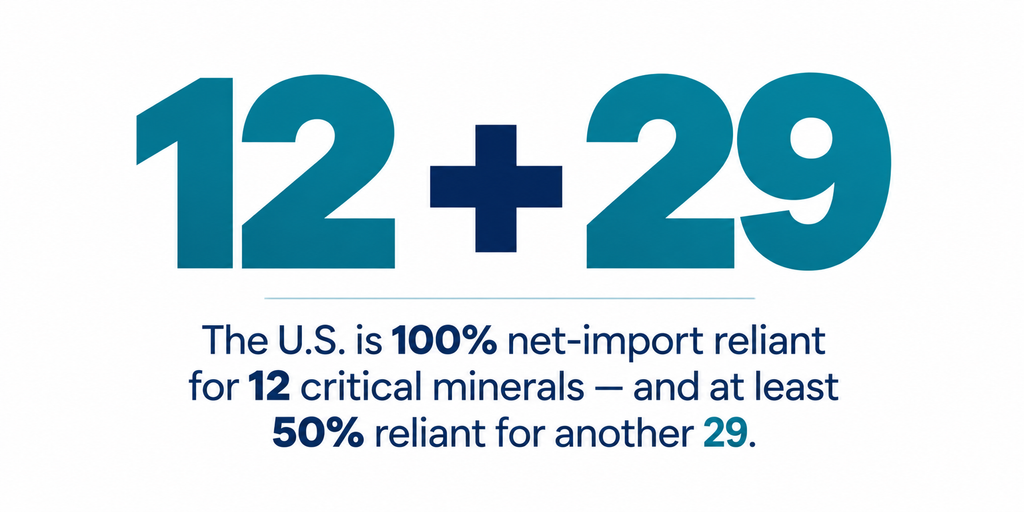
The United States, meanwhile, remains heavily reliant on imports for many critical minerals. According to the U.S. Geological Survey, the United States is 100% net-import reliant for 12 critical minerals and at least 50% reliant for another 29.
China has also demonstrated its willingness to restrict access to strategic materials, including through export controls affecting gallium, germanium, antimony, rare earths, and other critical materials.
These restrictions illustrate how concentrated supply chains can expose American manufacturers and defense industries to decisions made by foreign governments.
Mineral dependence can become industrial dependence.
What China Controls Can Ground the U.S. Military
Critical minerals are not simply commercial commodities. They are essential inputs for aircraft, ships, satellites, communications systems, sensors, missiles, electronics, and other advanced defense technologies.
In some cases, the minerals required are used in small quantities, but their absence can have outsized consequences.
Rare earth permanent magnets are one example. They are essential to numerous high-performance systems, while China holds a dominant position in the supply chain for the materials and magnets themselves.
Advanced military aircraft, including the F-35, rely on critical minerals in sensors, actuators, avionics, and electronic systems. Submarines, precision-guided weapons, radar, and unmanned systems also depend on specialized metals and components.
Strengthening access to these materials is an important part of maintaining America’s defense industrial base and its ability to produce advanced military equipment.
The Strategic Seafloor
China’s mineral strategy increasingly extends offshore.
Chinese entities hold exploration contracts covering all three major categories of deep-seabed mineral resources in international waters. China has also invested heavily in oceanographic research vessels, deep-sea mapping, submersibles, and other technologies that expand its ability to understand and operate in the deep ocean.
Through the International Seabed Authority, Chinese entities hold five exploration contracts covering polymetallic nodules, polymetallic sulfides, and cobalt-rich ferromanganese crusts. These activities give China access to mineral exploration opportunities while building experience with technologies needed for future deep-ocean operations.
Those capabilities have significance beyond minerals. Mapping, robotics, autonomous systems, sensing, and sustained deep-ocean operations can have commercial, scientific, and strategic applications.
The same vessels and underwater technologies used to survey mineral deposits can also contribute to broader knowledge of ocean conditions, underwater infrastructure, and strategically important maritime areas.
The competition therefore extends beyond who develops minerals first. It includes who builds the technology, operating experience, data, infrastructure, and rules that shape the next generation of deep-ocean industries.
The race for critical minerals is also a race for deep-ocean capability.
Processing is Power
Recovering minerals is only the first step.
Before nickel, cobalt, manganese, copper, and rare earth elements can become advanced materials, electronics, defense systems, or industrial equipment, they must be processed and refined.
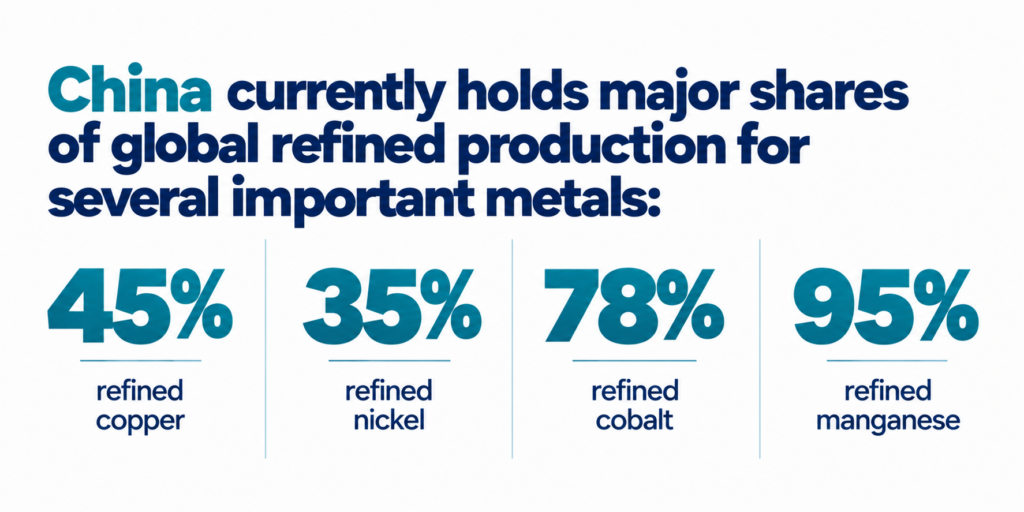
China currently holds major shares of global refined production for several important metals:
Approximately 45% of refined copper, 35% of refined nickel, 78% of refined cobalt, and 95% of refined manganese. These concentrations illustrate why mineral security depends on more than access to raw materials.
Developing a resource without developing the capacity to process it can simply move dependency from one part of the supply chain to another. For ocean minerals, that means ensuring recovered materials can move through American or allied processing facilities rather than relying exclusively on overseas refining capacity.
That is why American mineral security requires investment across the entire chain — from resource development through processing, refining, and manufacturing.
You don’t have mineral security if someone else controls the processing.
From New Resources to New Supply Chains
Meeting growing mineral demand will require more than finding new resources. America needs terrestrial mining, recycling, allied supply, new processing capacity, and new sources of minerals. Ocean minerals can add a potentially enormous, multi-metal resource to that portfolio.

Importantly, bringing those resources into the supply chain does not necessarily require inventing an entirely new industrial system at every step. In Japan, polymetallic nodules have already been processed through a commercial ferronickel production line, demonstrating a pathway for recovering nickel, copper, and cobalt while producing a manganese-rich product.
That pilot-scale demonstration showed how established metallurgical equipment can be adapted to process a new mineral feedstock. Additional testing and investment will be needed to determine how these approaches can operate economically at commercial scale.
The opportunity is to build on established technologies while expanding American and allied capacity to process, refine, and manufacture the materials industry needs.
From the seafloor to the factory floor, each step represents an opportunity to strengthen domestic industrial capabilities, support American jobs, and reduce exposure to concentrated foreign supply chains.